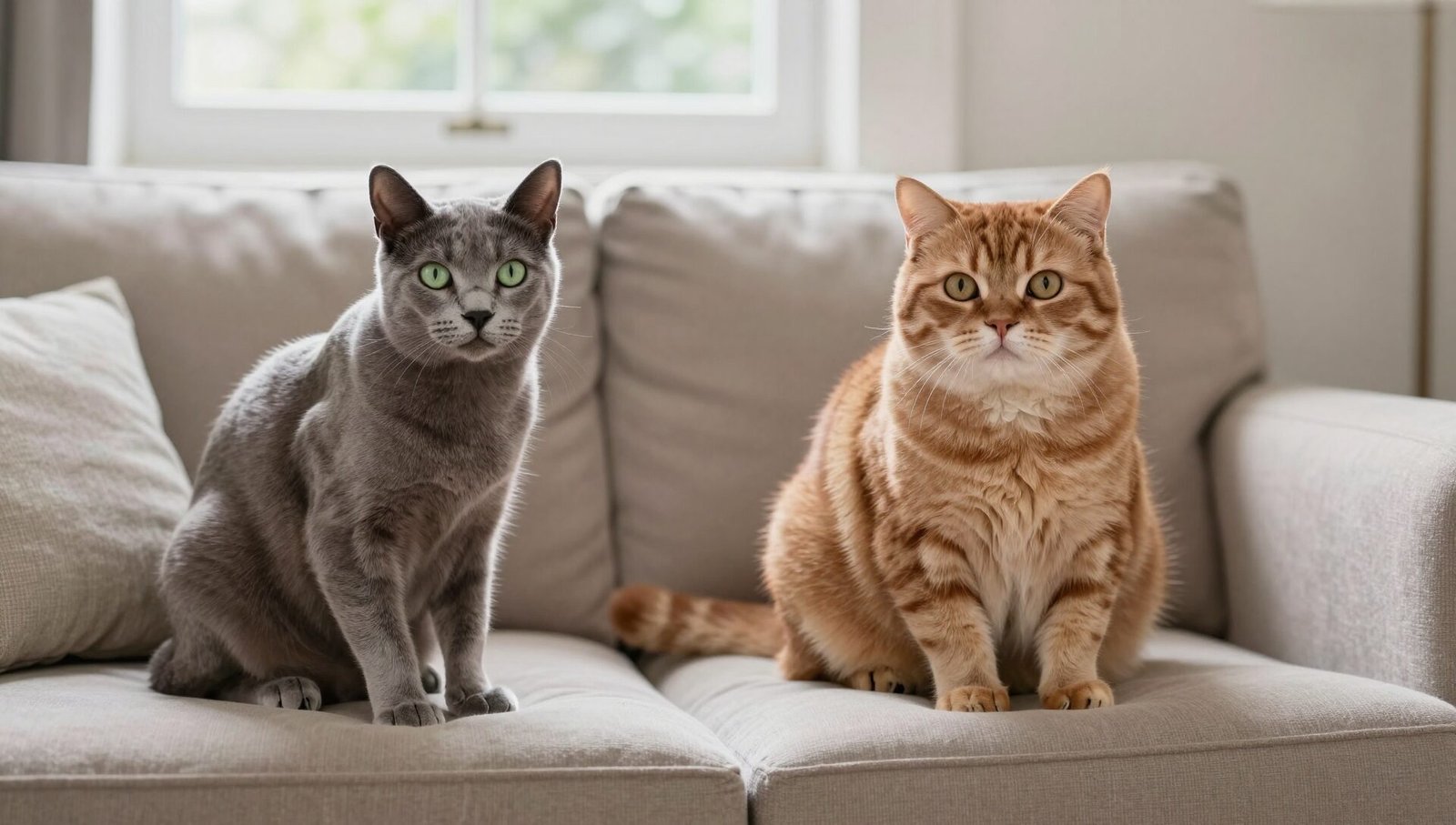
If you have ever walked into a rescue centre or scrolled through a breeder’s website and found yourself staring at two grey cats thinking, “Aren’t these the same cat?” — you are not alone. The Russian Blue vs British Shorthair debate trips up even seasoned cat owners, because both breeds wear that gorgeous blue-grey coat and both carry a reputation for being calm, dignified companions. I have been there myself, squinting at photos trying to work out which fluffy grey creature was which, and it took hands-on experience and a fair bit of reading before the differences became second nature.
Here is the thing: beneath that shared blue colouring, these are two very different cats with distinct personalities, body shapes, care requirements and health profiles. Choosing the wrong one for your lifestyle could mean a stressed cat and a frustrated owner — and nobody wants that. So in this guide I am going to walk you through every meaningful difference, from temperament and grooming to diet, enrichment and cost, all written with UK cat owners in mind. Whether you are a first-time kitten buyer or an experienced cat parent considering a new addition, by the end of this article you will know exactly which blue-grey beauty belongs in your home.
Let’s get into it. 🐱
Russian Blue vs British Shorthair: A Quick Snapshot
Before we dive into the details, here is a side-by-side comparison so you can see the key differences at a glance. I find tables like this invaluable when I am weighing up breeds — sometimes you just need the facts laid out plainly.
| Trait | Russian Blue | British Shorthair |
|---|---|---|
| Size | Medium, 3–5 kg | Medium to large, 4–8 kg |
| Body type | Slender, fine-boned, elegant | Stocky, cobby, round “teddy bear” |
| Coat | Short, dense double coat, silver-tipped | Short, dense, crisp single coat |
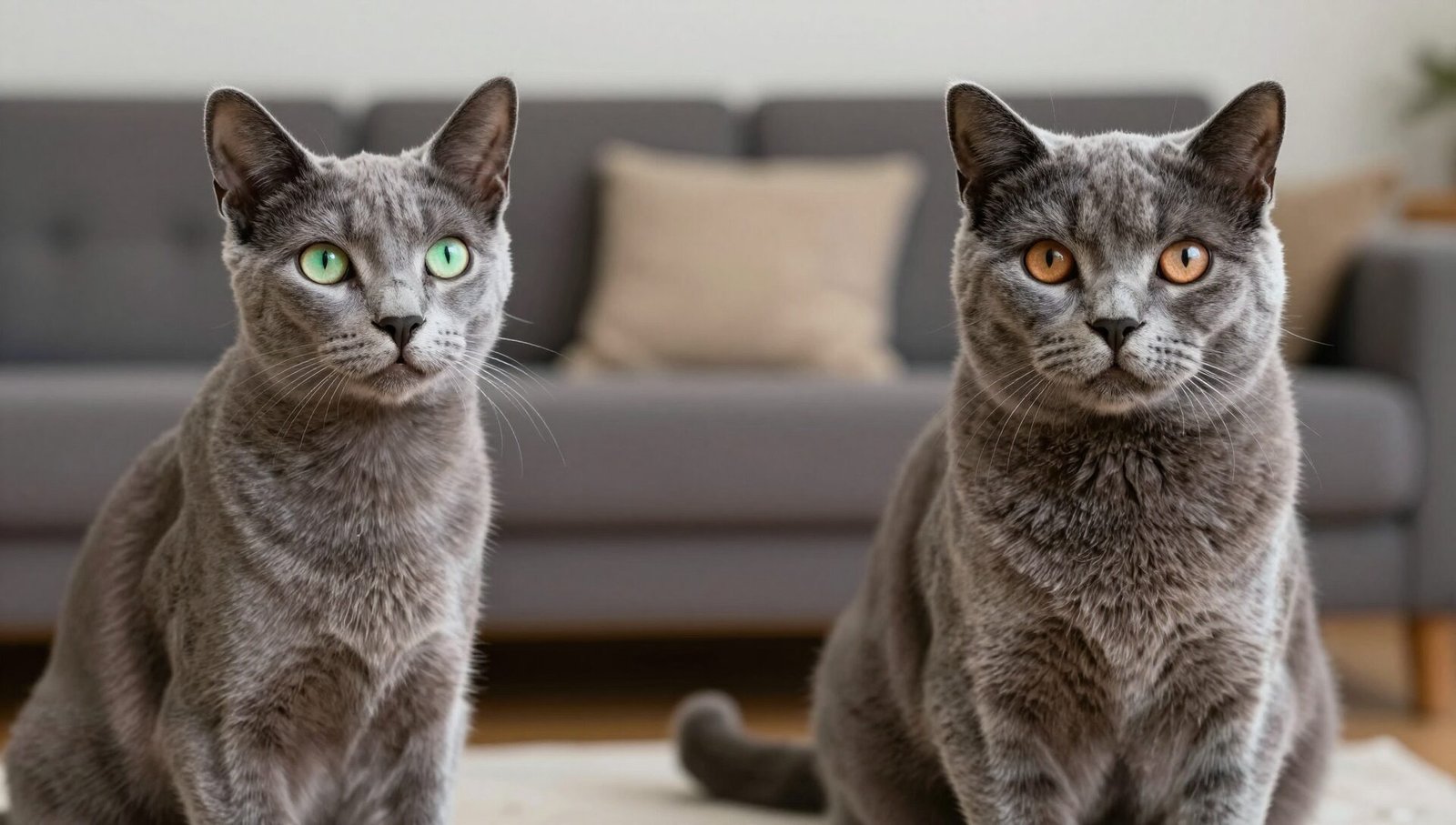
| Eye colour | Vivid emerald green | Deep copper or orange |
| Colours accepted | Blue only (in most registries) | Dozens of colours and patterns |
| Temperament | Shy with strangers, devoted to family | Calm, easygoing, independent |
| Lifespan | 12–20 years | 12–16 years |
| Grooming | Low — a few times a month | Low to moderate — weekly brushing |
| Price (breeder, UK) | £500–£1,500 | £800–£2,500+ |
| Best for | Calm homes, single owners | Families, busy households |
This snapshot covers the headlines, but every row deserves a deeper look. Read on and I will fill in the gaps with real-world advice you can actually use.
Origins and History
Understanding where a breed comes from tells you a lot about what it has been bred to value, and these two cats could not have more different origin stories.
The Russian Blue is a naturally occurring breed that traces its roots to the port city of Arkhangelsk in northern Russia — hence the nickname “Archangel Cat.” Sailors reportedly brought these blue-grey cats to Europe in the 1800s, and breeders in Britain and Scandinavia refined the type from there. The breed nearly vanished during the World Wars, and breeders outcrossed to British Shorthairs and Siamese cats to rebuild numbers before breeding back to the original elegant type. That wartime history is partly why the two breeds share a blue coat, even though they are otherwise unrelated.
The British Shorthair, by contrast, is Britain’s own pedigree darling. It descends from the common domestic cats of the British Isles, selectively bred from the late 1800s to create a sturdy, round-faced, heavy-boned cat. The solid blue (“British Blue”) became the most iconic colour, though today the breed comes in a rainbow of options. Harrison Weir, often called the father of the cat fancy, championed these cats at the first-ever cat show at the Crystal Palace in 1871.
So when someone asks me, “Are Russian Blues and British Shorthairs related?” — the honest answer is: only by wartime necessity, not by design. They are separate breeds with separate histories, and that matters when you are choosing a pet.
Appearance and Physical Traits
This is where the Russian Blue vs British Shorthair comparison becomes genuinely fun, because once you know what to look for, you can spot the difference from across a room.
The Russian Blue is built like a ballet dancer. Long, lean, fine-boned but muscular, with slender legs and a graceful, lithe frame. The head is a distinct wedge shape with large ears set wide apart, and the breed standard describes a subtle “Mona Lisa smile” — a slight upward curve to the mouth that gives the cat a gently enigmatic expression. The coat is a true double coat — a plush undercoat topped with guard hairs that are silver-tipped, giving the cat a signature frosted shimmer. You can literally trace a line in a Russian Blue’s fur with your finger and the line stays put. That stand-out texture is one of the breed’s most reliable tells.
The British Shorthair is the polar opposite silhouette. Broad-chested, short-legged, cobby and round, with full cheeks and jowls that give it that famous “teddy bear” face. The coat is very dense but described as “crisp” — it breaks over the body with a firmer, more wool-like feel rather than the plush stand-out of a Russian Blue. The eyes are round and deep copper or orange in the blue variety, and that warm contrast against the cool grey coat is what makes the British Blue so striking.
The five-second test: green eyes on a slim cat = Russian Blue. Copper eyes on a round cat = British Shorthair. Simple as that.
Temperament and Personality
For me, this is the section that actually matters most, because looks fade into the background once you are living with a cat day in, day out. And temperament is where these two breeds are genuinely worlds apart.
The Russian Blue is gentle, quiet and reserved. It is typically shy with strangers — when guests arrive, do not be surprised if your Russian Blue vanishes under the bed like a furry ghost. But with its own family, especially its chosen person, the Russian Blue bonds intensely. These cats are often described as “velcro” because they follow their favourite human from room to room, sit beside (or on) them constantly, and seem to absorb their owner’s moods. They are sensitive creatures. If you are stressed, your Russian Blue knows. They love routine and dislike chaos, loud environments and sudden change. They are also genuinely playful and intelligent — many learn to fetch, solve puzzle toys and even open doors.
The British Shorthair, on the other hand, is the feline equivalent of that mate who is happy to see you but does not need you to have a good time. Calm, easygoing, famously laid-back, and content to nap while you are at work. They are affectionate, certainly, but on their own terms — they are not usually lap-glued velcro cats. They tolerate children, dogs and busy households well, and they are not easily rattled by change. Both breeds are quiet and undemanding vocally, which is a blessing if you have ever lived with a vocal Siamese.
Bottom line: want a devoted shadow in a calm home? Go Russian Blue. Want a relaxed, independent family companion? Go British Shorthair.
Diet and Feline Nutrition
Here is a section many breed guides skip, and I think that is a mistake, because diet is where new cat owners often go wrong — and both of these breeds have a particular vulnerability you need to know about.
Both the Russian Blue and the British Shorthair are prone to obesity. The Russian Blue is famously food-motivated (mine would sell state secrets for a prawn), and the British Shorthair, with its naturally stocky build, gains weight easily if portions are not controlled. Free-feeding — leaving a bowl of dry food out all day — is a recipe for a fat cat with either breed. I learned this the hard way with my first cat, who ballooned before I switched to measured meals.
Here are my practical feeding tips:
- Measure every meal. Use kitchen scales or a measuring cup and follow the guidelines on the food packaging as a starting point, then adjust based on your cat’s body condition.
- Wet food is your friend. A high-quality wet food provides hydration and is generally lower in calories per serving than dry. I aim for a mix of both.
- Treats in moderation. Use treats for training and enrichment, not as a dietary staple. Aim for no more than 10% of daily calories.
- Kitten nutrition matters. If you are bringing home a kitten, feed a specifically formulated kitten food until around 12 months. Growing bodies need the extra protein and calories.
- Talk to your vet. A vet-guided feeding plan does more for your cat’s lifespan than almost anything else.
If you have a picky eater — and Russian Blues can be particular — try warming wet food slightly to release the aroma, or adding a small amount of tuna water on top. Patience and consistency win the day.
Grooming Needs and Coat Care
Neither breed is high-maintenance in the grooming department, which is music to the ears of busy owners. But there are differences worth noting.
The Russian Blue’s plush double coat is relatively self-maintaining. A comb-through two or three times a month keeps it in good shape, removes loose hair and distributes the natural oils that give the coat its shimmering sheen. Because the coat is so dense, it tends to trap dander close to the skin rather than shedding it into the air — which is one reason Russian Blues have a reputation as a better choice for allergy sufferers.
The British Shorthair’s crisp, dense coat also requires relatively low grooming — a weekly brush is usually sufficient for most of the year. However, British Shorthairs do go through heavier seasonal sheds (typically spring and autumn), during which you will want to brush more frequently. Invest in a good slicker brush and a de-shedding tool, and you will save your sofa in the process.
A quick note on allergies: neither breed is truly hypoallergenic. The Russian Blue is often reported to produce somewhat lower levels of the Fel d 1 protein (the main cat allergen found in saliva and skin), but every cat produces some. If allergies are a genuine concern, spend time with an adult cat of the breed before committing. Do not rely on internet promises.
Health, Lifespan and Vet Care
Both breeds are generally hardy and long-lived, which is reassuring. But each has breed-specific health concerns that responsible owners should be aware of.
The Russian Blue averages 12–15 years and commonly reaches 15–20, making it one of the longer-lived pedigreed cats. Its primary health risk is obesity-related conditions (diabetes, joint strain), and less commonly, bladder or urinary stones. In some lines, progressive retinal atrophy (PRA) and polycystic kidney disease (PKD) have been reported. Responsible breeders screen for these.
The British Shorthair typically lives 12–16 years. The breed-specific concern to ask your breeder about is hypertrophic cardiomyopathy (HCM), a thickening of the heart muscle that is the most common heart disease in cats. Again, weight management is critical — a chunky British Shorthair is not a “cute” British Shorthair; it is a health risk in the making.
My advice for either breed:
- Register with a good vet early. Get your kitten checked within the first week of bringing them home.
- Keep vaccinations up to date. In the UK, core vaccinations include feline panleukopenia, cat flu (feline herpesvirus and calicivirus) and ideally feline leukaemia virus.
- Insure your cat. Vet bills in the UK can be eye-watering, and breed-specific conditions make insurance particularly worthwhile.
- Annual health checks. Even if your cat seems perfectly healthy, an annual vet visit catches problems early.
Indoor Living, Enrichment and Training
In the UK, many cat owners keep their cats indoors — whether by choice, location or veterinary recommendation. Both breeds adapt well to indoor living, but their enrichment needs differ slightly because of their temperaments.
The Russian Blue is an intelligent, playful cat that genuinely needs mental stimulation. Without it, you risk a bored, anxious cat — and a bored Russian Blue may develop destructive habits or stress-related behaviours. I recommend:
- Puzzle feeders to engage that clever brain
- Interactive play sessions (wand toys, laser pointers used safely) for at least 15–20 minutes daily
- Vertical space — cat trees, shelves and window perches give a naturally shy cat places to observe safely
- Routine, routine, routine. Russian Blues thrive on predictability
The British Shorthair is more laid-back but still needs enrichment. They enjoy play but are often happy with shorter sessions and will then retire for a dignified nap. Scratching posts are essential for both breeds — invest in a sturdy, tall post (or several) to save your furniture. Sisal-wrapped posts tend to be the most popular.
Litter training is generally straightforward with both breeds — most kittens come litter-trained from reputable breeders. Use a large, open litter tray with unscented clumping litter, and place it in a quiet, accessible spot. The golden rule is one litter tray per cat, plus one extra.
Both breeds respond well to positive-reinforcement training. Russian Blues in particular can learn tricks, fetch and even walk on a harness with patience and consistency.
Pros and Cons of Each Breed
No breed is perfect. Here is my honest breakdown:
Russian Blue — Pros
- Deeply loyal and affectionate with family
- Lower allergen reputation (good for mild allergy sufferers)
- Beautiful silver-tipped coat with minimal grooming
- Intelligent, playful, trainable
- Long lifespan
Russian Blue — Cons
- Shy and anxious around strangers and in chaotic homes
- Prone to obesity if overfed
- Needs more mental stimulation and enrichment
- Can bond to one person and be aloof with others
British Shorthair — Pros
- Calm, easygoing, tolerant of children and other pets
- Adapts well to busy households
- Wide variety of colours and patterns available
- Independent and content alone during the day
- Iconic “teddy bear” appearance
British Shorthair — Cons
- Prone to HCM (heart condition) — ask breeders for screening
- Can become overweight easily
- Less interactive — may not satisfy owners wanting a “lap cat”
- Generally more expensive to purchase from a breeder
Which Breed Is Right for You?
Choosing between a Russian Blue vs British Shorthair ultimately comes down to your lifestyle, household and what you want from your relationship with your cat.
Choose the Russian Blue if:
- You live in a calm, fairly predictable household
- You want a deeply bonded, interactive companion
- You do not mind a cat that hides when visitors come round
- You have mild cat allergies and want a breed with a lower-allergen reputation
- You enjoy training and playing with your cat
Choose the British Shorthair if:
- You have a busy family home with children or other pets
- You want an independent cat that is happy while you are at work
- You prefer a laid-back, undemanding companion
- You want a wider choice of coat colours and patterns
- You love the classic round-faced “teddy bear” look
There is no wrong answer here — both are wonderful, long-lived, good-natured cats. The right breed is simply the one that fits your life.
Frequently Asked Questions
What is the main difference between a Russian Blue and a British Shorthair?
The quickest way to tell them apart is by body type and eye colour. A Russian Blue is slender and fine-boned with vivid emerald-green eyes, while a British Shorthair is stocky and round with deep copper or orange eyes. Their temperaments also differ significantly: the Russian Blue is shy and deeply bonded to its family, while the British Shorthair is calm, easygoing and more independent.
Are Russian Blue cats good for allergy sufferers?
Russian Blues are often reported to produce lower levels of the Fel d 1 allergen, and their dense double coat tends to trap dander close to the skin. However, no cat is truly hypoallergenic. If you have allergies, spend time with an adult Russian Blue before committing to ownership.
Do British Shorthairs get along with children and other pets?
Yes — the British Shorthair is one of the most family-friendly pedigree breeds. They are famously tolerant of children, dogs and other cats, thanks to their calm, laid-back temperament. They are not easily rattled by noise or activity, making them an excellent choice for busy households.
Which breed lives longer, the Russian Blue or the British Shorthair?
The Russian Blue generally has the longer lifespan, commonly reaching 15–20 years, while the British Shorthair typically lives 12–16 years. Both are long-lived compared to many other pedigree breeds, and lifespan can be maximised with proper diet, weight management and regular veterinary care.
How much does a Russian Blue or British Shorthair kitten cost in the UK?
From a reputable UK breeder, a Russian Blue kitten typically costs £500–£1,500, while a British Shorthair kitten commonly starts around £800–£2,500, with rare colours like golden or silver fetching significantly more. Always insist on pedigree papers, health screening certificates and meeting the kitten’s parents.
Can I keep a Russian Blue or British Shorthair as an indoor cat?
Absolutely — both breeds adapt well to indoor living. The Russian Blue will need more mental enrichment (puzzle toys, interactive play, vertical space) to stay stimulated, while the British Shorthair is naturally more content to lounge. Provide scratching posts, cat trees and regular play sessions for either breed.
Conclusion
The Russian Blue vs British Shorthair debate is not about which breed is objectively better — because neither is. It is about which cat fits your life. The Russian Blue offers a quiet, intense, deeply loyal bond in a slender, green-eyed package, best suited to calm homes and devoted owners. The British Shorthair offers a relaxed, easygoing, independent companionship in a stocky, copper-eyed teddy-bear frame, ideal for families and busy households.
Both are beautiful, long-lived, relatively low-maintenance cats that make wonderful companions. The key differences come down to build (slim vs round), eye colour (green vs copper), temperament (velcro vs independent) and lifestyle fit. Get those right, and you will have a happy cat and a happy home.
If you are still on the fence, visit a breeder or rescue and meet both breeds in person. Nothing replaces the feeling of a cat choosing you — and whichever blue-grey beauty walks into your life, I promise you will not regret it. 🐾