If you are currently staring at a plush, grey cat wondering if it’s a Russian Blue vs British Blue cat, you are not alone. It’s a common conundrum for feline enthusiasts! They are the feline world’s answer to identical twins who grew up on different continents. While they share that stunning, shimmering blue-grey coat, they are fundamentally different creatures in terms of build, personality, and care requirements.
As someone who has spent years navigating the nuances of cat care, I can tell you that choosing between these two isn’t just about picking the prettiest shade of grey. It’s about matching the cat’s temperament to your own lifestyle. One is a reserved, agile athlete; the other is a stoic, teddy-bear-like companion. In this guide, we’ll break down the Russian Blue vs British Blue cat debate, helping you decide which of these magnificent felines deserves a spot on your sofa.
Origins and History
To understand the cat, you have to look at its roots. The history of these breeds explains a lot about why they act the way they do today.
The Russian Blue is steeped in mystery and aristocracy. Hailing originally from the port of Arkhangelsk (Archangel) in Russia, they were known as Archangel Blues. Legend has it that they were the favoured pets of Russian Czars. They were brought to Europe by sailors in the 1860s. They are a natural breed, meaning they developed without much human intervention, which contributes to their robust genetic health.
On the other hand, the British Blue is the quintessential British domestic pedigree. While we often associate them with the UK, their ancestors are believed to be cats brought from Egypt that bred with European wildcats. In the late 19th century, breeders like Harrison Weir began selectively breeding these cats to be robust, powerful, and suited to the British climate. The British Blue is technically a colour variant of the British Shorthair (BSH), but it is by far the most popular and iconic variety.
Physical Appearance
When it comes to the Russian Blue vs British Blue cat physique, it’s a bit like comparing a ballet dancer to a wrestler. Both are impressive, but built for very different purposes.
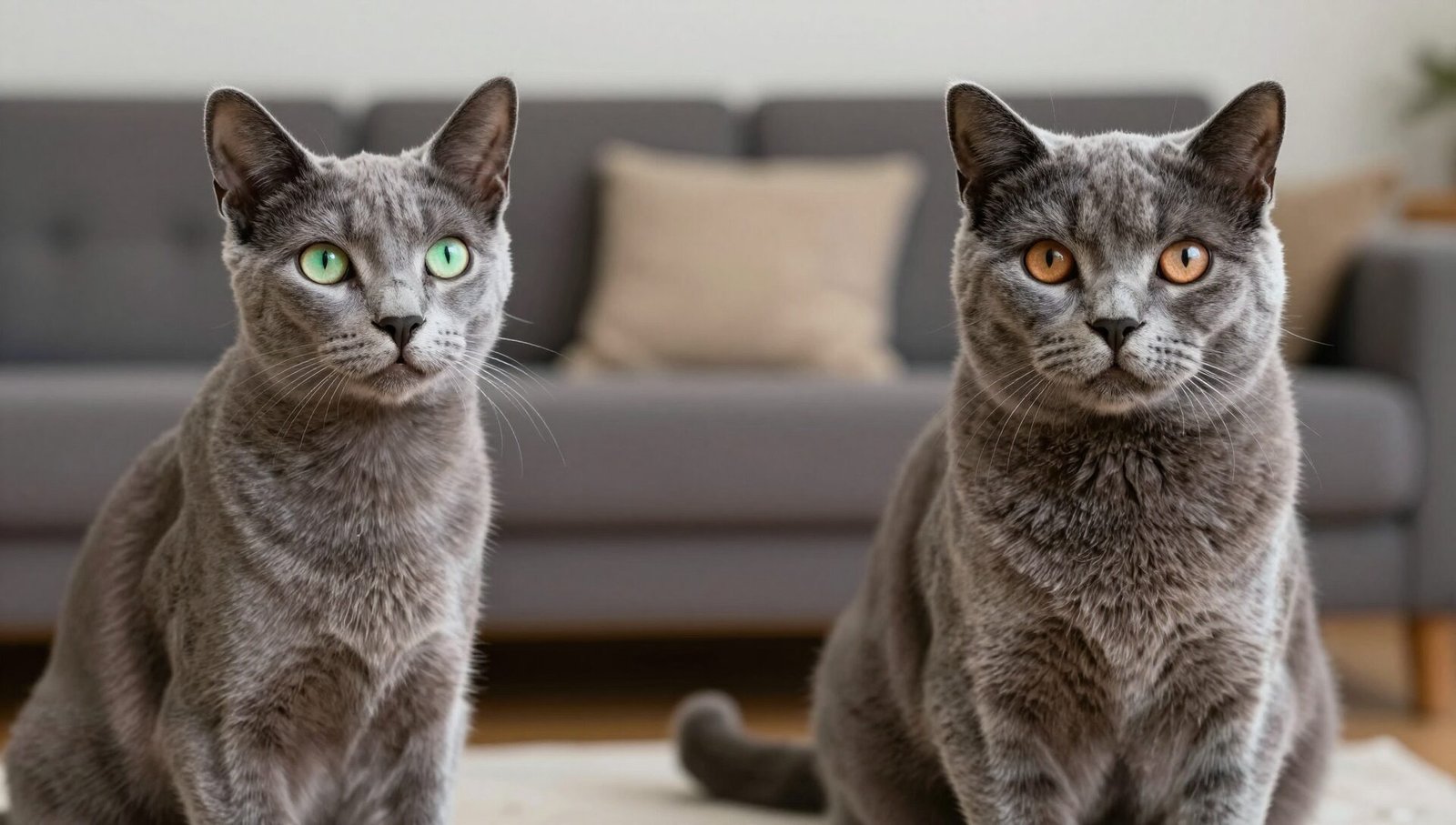
The Russian Blue is all about elegance. They have a slender, muscular body with long legs. Their head is a distinct wedge shape, and their large ears are set wide apart, giving them an alert, almost surprised expression. The standout feature? Their eyes. Russian Blue kittens are born with yellow eyes, but as they mature, these transform into a vivid, striking emerald green.
The British Blue, conversely, is the definition of “chonky.” They are medium-to-large cats with a dense, powerful build. Their face is round with full cheeks (often called “jowls” in adult males) and a broad nose. Their eyes are large and round, typically a deep copper or gold colour. They look perpetually serious and incredibly cuddly.
Here is a quick comparison of their physical attributes:
| Feature | Russian Blue | British Blue |
|---|---|---|
| Body Type | Slender, elegant, athletic | Stocky, powerful, teddy-bear |
| Head Shape | Wedge-shaped, angular | Round, full cheeks |
| Eye Colour | Vivid Green | Gold/Copper |
| Weight | 3–5 kg | 4–8 kg |
| Ears | Large, pointed | Small, rounded tips |
Temperament and Personality
This is where the Russian Blue vs British Blue cat differences really start to show. If you want a cat that acts like a dog, you have a choice to make: do you want a cat that fetches or a cat that follows you around but doesn’t bring the ball back?
The Russian Blue is the more sensitive and intelligent of the two. They are often described as having an “INFJ” personality type in the feline Myers-Briggs world. They form incredibly strong bonds with their owners and can be shy or reserved around strangers. They are active, playful, and love interactive toys. However, they are creatures of habit; they dislike change and can get stressed if their routine is disrupted.
The British Blue is the stoic “ISTJ.” They are independent, quiet, and dignified. They aren’t as high-energy as the Russian Blue. While they enjoy a play session, they are just as happy to watch the world go by from a windowsill. They are less demanding of attention and are generally more robust in the face of household changes. If you want a cat that is affectionate but won’t constantly demand your lap, the British Blue is a winner.
Russian Blue vs British Blue Cat: Coat and Grooming
Both cats have short, dense double coats, but the texture differs significantly. When you run your hand over a Russian Blue, the fur feels incredibly soft, plush, and velvety. It stands upright due to the density, meaning you can actually draw patterns in their fur that stay until you smooth them out. It has a shimmering, silver-tipped sheen.
The British Blue has a “crisp” coat. It feels less like velvet and more like a dense, plush carpet or a teddy bear. It breaks over the body contours rather than lying flat.
Grooming Needs:
- Brushing: Neither breed is high maintenance, but the British Blue requires more frequent brushing (twice a week) because their dense coat is prone to matting, especially around the neck. The Russian Blue needs a quick brush once a week.
- Shedding: Both shed! The British Blue sheds heavily twice a year (blowing their coat), while the Russian Blue sheds more consistently but lightly.
Diet and Nutrition
When comparing the Russian Blue vs British Blue cat dietary needs, weight management is the biggest factor.
The Russian Blue is notoriously food-obsessed. They are “vacuum cleaners” who will eat anything, anytime. If you free-feed a Russian Blue, you will quickly end up with a spherical cat. You need strict portion control and high-protein, low-carb food to keep them lean.
The British Blue also loves their food and is prone to obesity. However, because they are naturally stockier, owners sometimes mistake chubbiness for their natural build. This breed needs a diet rich in lean protein to maintain muscle mass without packing on fat.
Nutrition Tips:
- Protein: Aim for wet food with at least 50% meat content.
- Schedule: Avoid free-feeding. Set meal times.
- Treats: Use treats sparingly for training, not just for snacking.
Health and Lifespan
Generally, both are healthy breeds, but they have distinct genetic predispositions to watch out for. The Russian Blue tends to live slightly longer, often reaching 15–20 years, while the British Blue averages 12–20 years.
| Health Concern | Russian Blue | British Blue |
|---|---|---|
| Primary Issues | Obesity, Urinary Tract Issues | Hypertrophic Cardiomyopathy (HCM), Polycystic Kidney Disease (PKD) |
| Joint Issues | Generally robust | Arthritis in senior years |
| Dental | Good | Prone to gum disease |
Regular vet check-ups are non-negotiable. I recommend a check-up every 6 months for cats over 8 years old.
Living Environment
The Russian Blue is sensitive to cold but loves to explore. They are perfectly suited to indoor living provided they have vertical space (cat trees, shelves) and stimulation. They can get bored easily, leading to behavioural issues.
The British Blue is the ultimate indoor cat. They are low-energy and not particularly agile (jumping isn’t their forte). They are happy in flats or smaller homes as long as they have a comfy bed and a scratching post.
Pros and Cons
To summarize the Russian Blue vs British Blue cat debate, here is a balanced look at the pros and cons of each.
Russian Blue:
- Pros: Stunning appearance, highly intelligent, loyal, good for allergy sufferers (produces less Fel d 1), long lifespan.
- Cons: Shy with strangers, demands attention, can be destructive if bored, prone to obesity.
British Blue:
- Pros: Calm and easy-going, independent, great with kids/dogs, classic look, minimal grooming beyond shedding season.
- Cons: Prone to heart/kidney issues, stubborn, hates being picked up, heavy shedding season.
Is the Russian Blue or British Blue Right for You?
So, how do you choose between a Russian Blue vs British Blue cat?
Choose the Russian Blue if:
- You work from home or have a quiet household.
- You want an interactive, playful companion.
- You or a family member has mild cat allergies.
- You enjoy a cat that learns tricks and plays fetch.
Choose the British Blue if:
- You have a busy lifestyle and work long hours.
- You have young children or other pets.
- You want a cat that is “seen and not heard.”
- You prefer a cuddly, teddy-bear look.
Frequently Asked Questions
Are Russian Blues and British Blues hypoallergenic?
The Russian Blue is often cited as being hypoallergenic because they produce lower levels of the Fel d 1 protein, which is the primary allergen in cats. The British Blue is definitely not hypoallergenic and sheds heavily, so they are not ideal for allergy sufferers.
Which breed is more expensive, the Russian Blue or British Blue cat?
Generally, British Shorthairs are slightly more expensive due to their popularity and breeding costs, often ranging from £800 to £1,500. Russian Blues typically range from £700 to £1,200. Prices vary based on lineage and breeder reputation.
Do Russian Blues and British Blues get along with dogs?
Yes, both breeds are known for their adaptability. The British Blue is particularly stoic and tolerant of dogs. The Russian Blue can get along with dogs too, provided the introduction is slow and the dog isn’t too boisterous.
Are Russian Blues clingy?
Russian Blues are known to be “Velcro cats.” They tend to bond deeply with one person and will follow them from room to room. They aren’t usually “lap cats” in the sense of sitting on you constantly, but they always want to be near you.
How can I tell if my kitten is a Russian Blue or a British Blue?
Look at the eyes and ears first. Russian Blue kittens will have large, triangular ears and their eyes will eventually turn green. British Blue kittens have smaller, rounded ears and their eyes will turn gold or copper.
Which cat is better for a first-time owner?
For a first-time owner, the British Blue is often easier. They are less demanding, more independent, and less sensitive to changes in the environment than the Russian Blue.
Conclusion
Choosing between a Russian Blue vs British Blue cat comes down to your personal lifestyle and what you want in a feline companion. If you crave an active, intelligent, and somewhat needy partner who will play fetch and gaze at you with emerald eyes, the Russian Blue is your match. If you want a calm, independent, and stoic friend who looks like a living teddy bear and is happy to coexist quietly, the British Blue is the one for you.
Both breeds offer the joy of owning a magnificent blue-grey cat. Whichever you choose, ensure you are prepared for the commitment of cat care, providing them with the right diet, enrichment, and love they deserve.